seven minute read
How many driving lessons does it actually take?
The honest answer is a range, and four things move it — none of which is how clever you are.
37-32 61st Street, Woodside, NY 11377
The journal
Fifteen of the fifty supervised hours must be after sunset, and there is a reason the State counts them separately.
A candidate under eighteen has to give the examiner a certification of fifty hours of supervised driving practice — and the form does not say “fifty hours, some of it at night”. It says fifty hours including fifteen hours after sunset, counted apart, on their own line.
That separation is the whole point. Night driving is not a slightly harder version of day driving with the same skills applied more carefully. It is a different task performed with the same controls, and the hours you have accumulated in daylight transfer less than anybody expects.
The certification is signed by a parent or guardian, not by a school, and a false statement on it is a misdemeanour. How the hours are counted and who signs for them.
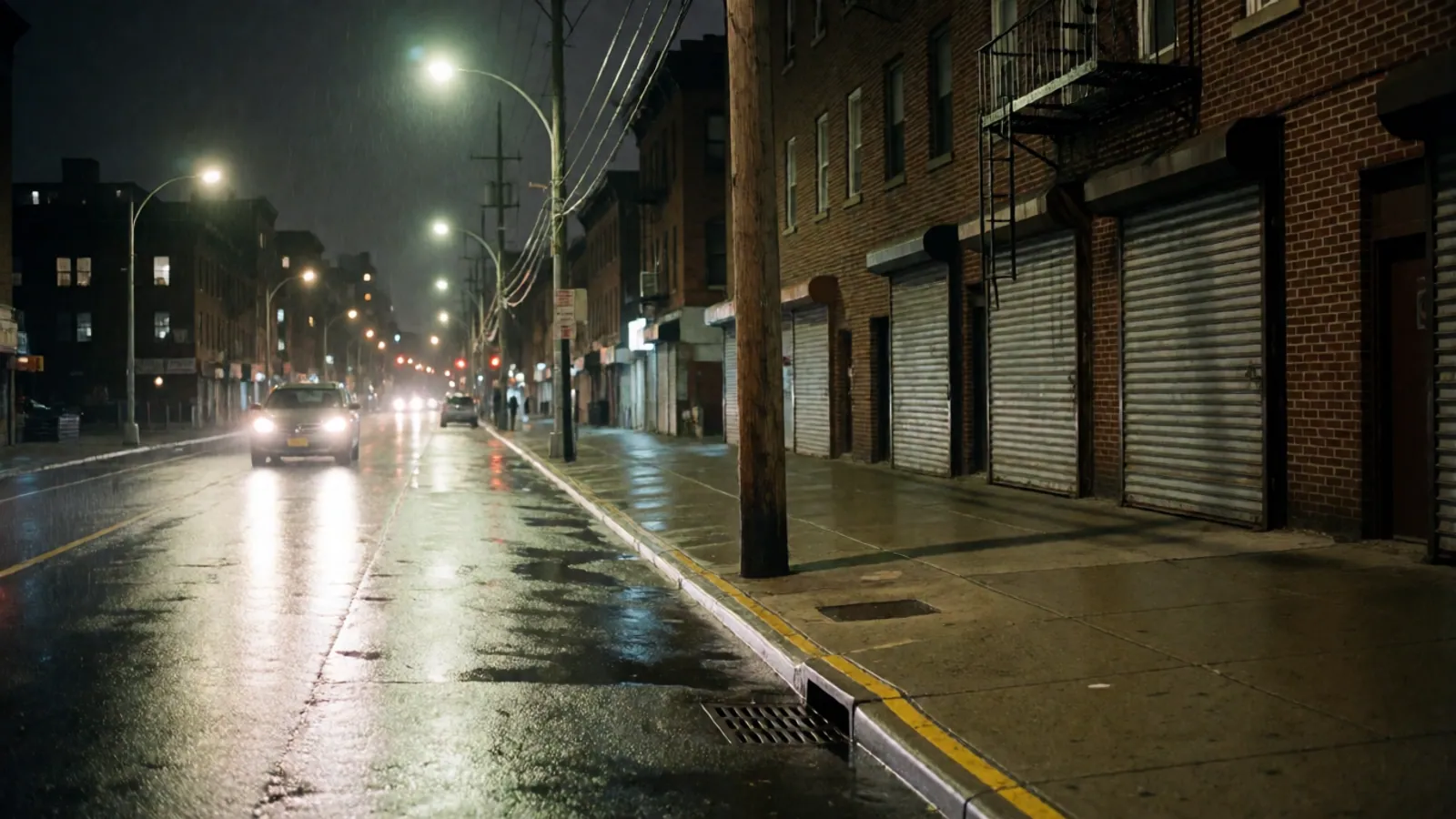
Your headlights reach a fixed distance down the road. The road does not get shorter to match, and neither does the distance the car needs to stop. Most of what feels like nerves at night is a driver correctly noticing that they are being asked to decide with less information than they had an hour earlier.
A pair of headlights coming the other way is two points of light, and two points of light carry almost no information about how far away they are or how fast they are closing. Judging a gap for a left turn is the manoeuvre this affects most, and it is the one worth practising deliberately rather than meeting for the first time alone.
Oncoming lights, and a wet road that turns every one of them into a smear across the surface you are trying to read. Rain at night is not two problems added together; it is a third, different one, and it is the single most common reason a driver who is fine in the dark is not fine on a particular evening.
This is the part that surprises people who have driven at night elsewhere. A lit avenue, then a dark side street, then a lit avenue again — and eyes take time to cross between them. Driving here after dark is less about darkness than about repeatedly adjusting to the wrong amount of light.
Fewer vehicles and faster ones. Fewer pedestrians, harder to see, and more of them crossing away from a junction. The street is emptier and the consequences of misreading it are larger, which is an uncomfortable combination to meet for the first time on your own.
Here is the thing almost nobody knows until they need to. A junior learner permit holder may not drive anywhere in the five boroughs of New York City between 9 pm and 5 am, under any circumstances. Not with a parent. Not with an instructor. Not at all.
Between 5 am and 9 pm they may — but only under the direct supervision of a parent, a guardian, a person in loco parentis, a driver education teacher or a driving school instructor, who must be at least twenty-one and hold a licence valid for the vehicle; and the vehicle itself must have dual controls. Read that last condition twice, because a family car does not have them.
Two consequences follow, and the second is the one that costs families time. The first: an under-eighteen candidate in this city has to find every one of their fifteen after-sunset hours between sunset and 9 pm. In June that window barely exists. In December it is wide. The night hours are a winter job in New York City, and a family that leaves them to the end of the summer discovers this in the worst possible week. Learner permit restrictions at the DMV (opens dmv.ny.gov in a new tab)
The second: in the five boroughs, the dual-control requirement means a junior permit holder's lawful practice is narrower than a parent assumes. That is obviously a rule that sends business to driving schools, which is exactly why you should read it on the State's page rather than take it from ours. It is also why the rule for a junior licence — which cannot be used inside the city at all — gets confused with the rule for a junior permit, which can, in daylight, with conditions. They are different rules and getting them the wrong way round is the commonest mistake in this trade's writing.
None of the above applies to anybody eighteen or over: an adult learner permit holder needs a supervising driver aged twenty-one or older with a valid licence for the vehicle, and no curfew and no dual controls. The page for parents sets out the difference in full.
Danilo Cruz is the reason this school sells night lessons at all. Danilo has the late diary, which makes him the school's night-driving instructor from November to February. He teaches the bridge approaches and the ramps onto the Brooklyn-Queens Expressway.
He works Tuesday to Sunday, 10 am to 7 pm. The last standard lesson of his day starts at 5:30 pm, and a longer one starts earlier than that, because the diary has to hold the lesson plus the twenty minutes he needs to reach whoever is next. From about November to February, both of those are genuinely dark.
A night lesson is booked as an hour and a half rather than one hour, because a lesson after dark that is worth having includes the drive out to somewhere with the right kind of light and the drive back through somewhere with the wrong kind, and an hour spends most of itself on the first of those.
And the honest limit: from roughly May to August there is very little genuinely dark time inside anybody's working day here. We will say that on the telephone rather than sell you a lesson at dusk in July and call it night driving. If the hours are what you need, the months to book them in are the cold ones.
The same credit. There is no night surcharge and no surcharge of any kind on this site. A lesson after dark costs a credit, exactly like a lesson in daylight, and the prices page prints every figure with the number of lessons and the length of each beside it.
That a night lesson will make you safe after dark. It will make you less surprised, which is a different and more honest claim. The rest is accumulated hours and the only place to get those is behind a wheel, most of them with somebody who is not us.
And nothing about those hours is a promise about a test. What an examiner is actually watching is a separate piece, and the honest answer there is the same as it is here: we are not in the car that morning.
Six pieces about learning to drive in this borough, written by the people who teach it.
seven minute read
The honest answer is a range, and four things move it — none of which is how clever you are.
six minute read
What the first hour is actually spent on, minute by minute, including the ten minutes the car does not move.
Reserve a package and it becomes credits. Then pick an instructor, a date and a time out of the real diary, and give us the address to pick you up from. Nothing is paid on this website.